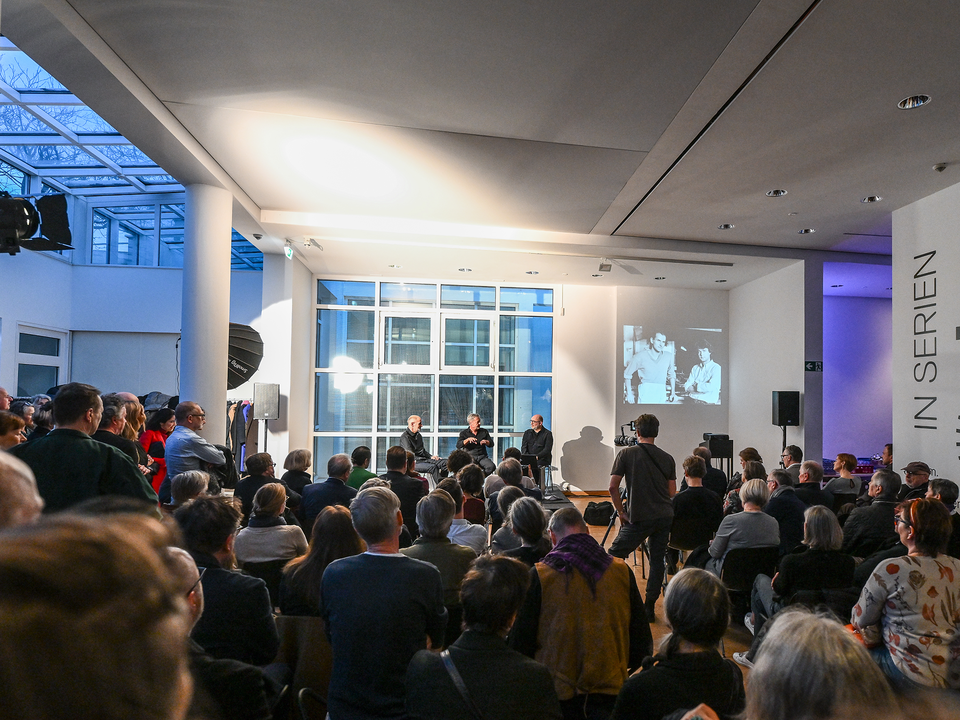
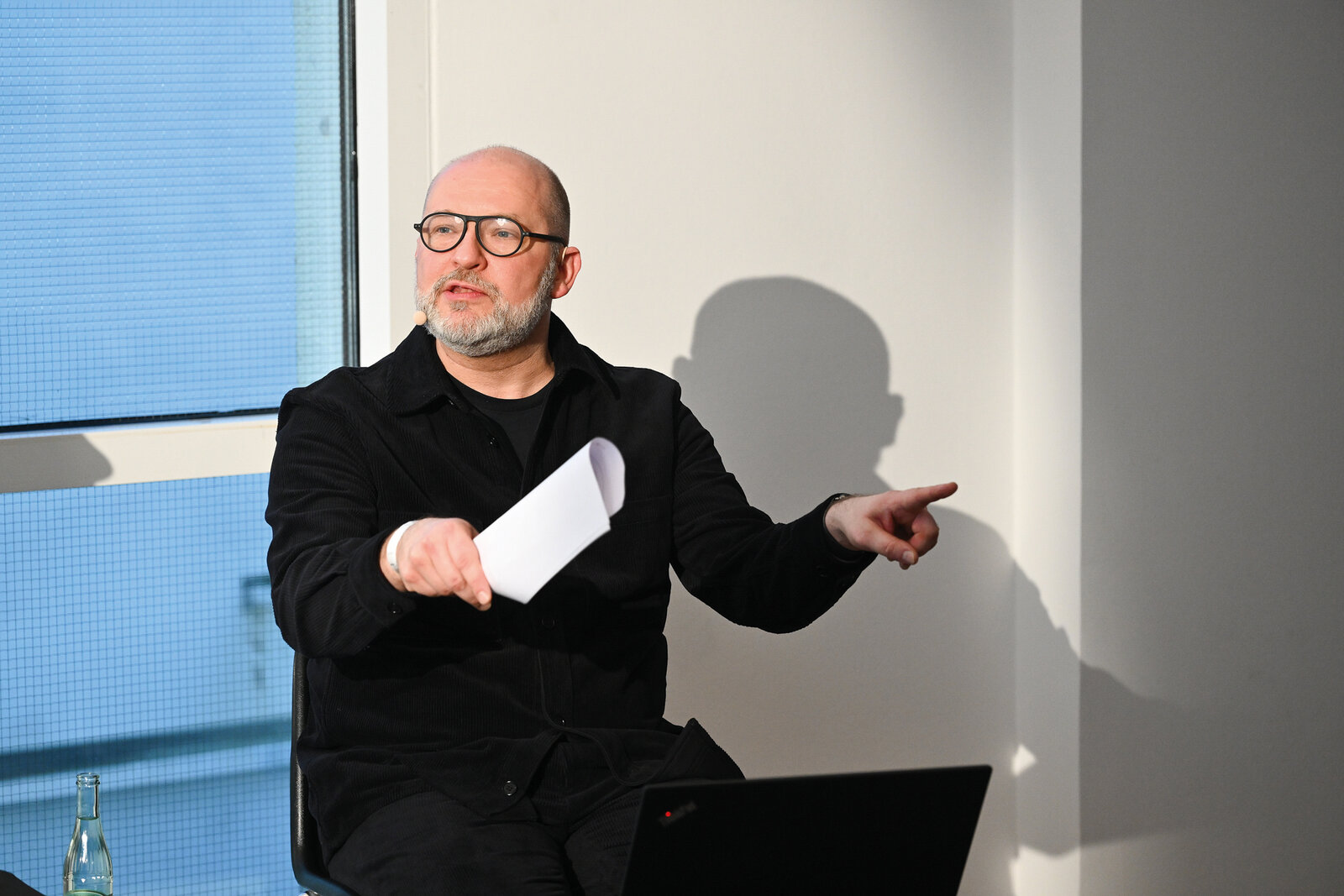
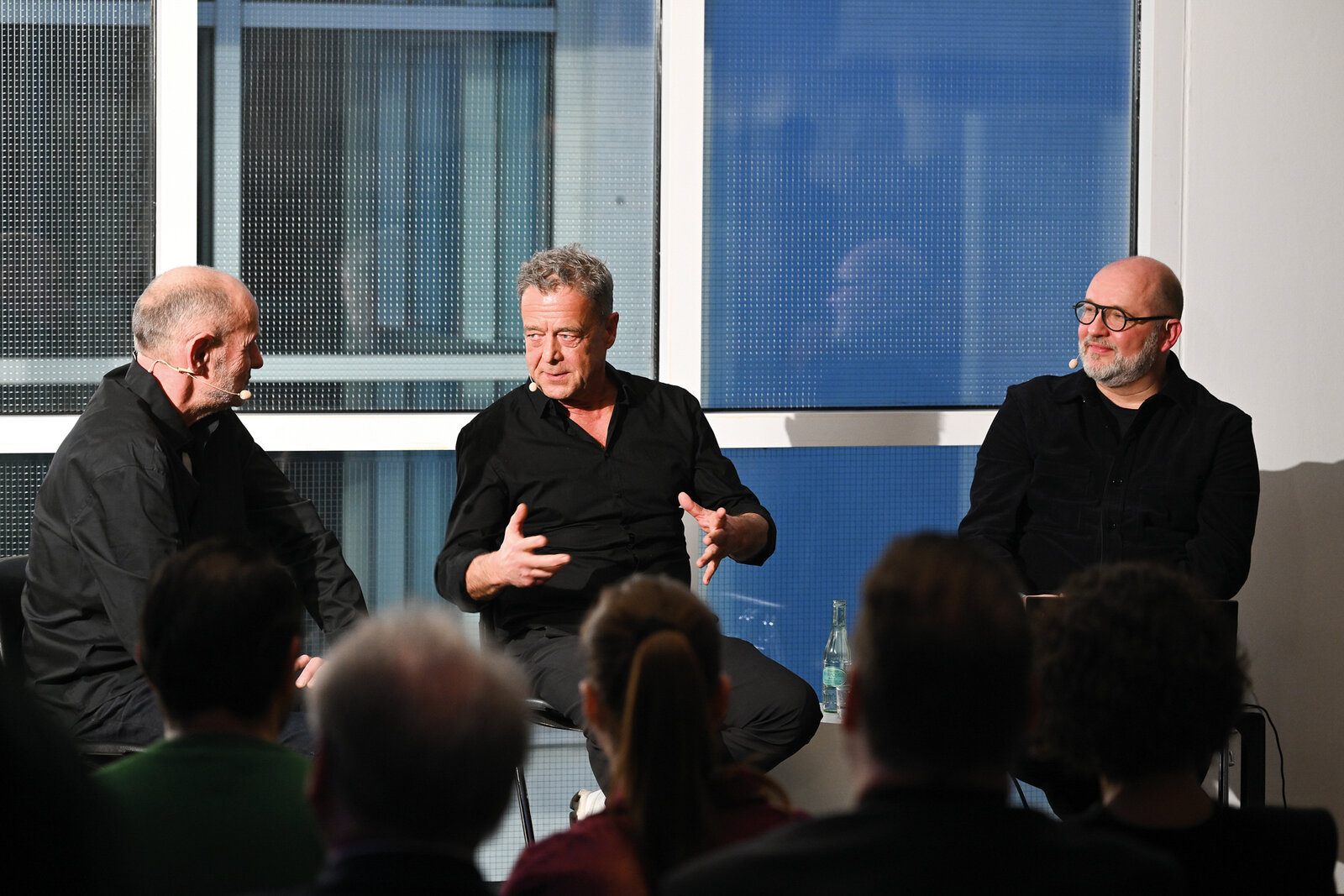
MF: I am very pleased that serien has asked me to host this talk this evening and to read out a little as well. My name is Markus Frenzl. I am Professor of Design and Media Theory in Munich, and it is probably not necessary, but I would very much like to introduce the two founders of serien.lighting to you: Manfred Wolf and Jean-Marc da Costa.
Through many text projects we have done together, I have been connected with serien for a long time and am also friends with them. My first indirect contact with serien, however, actually goes back to 1991, when I began my design studies at HfG Offenbach. Back then you were already there, namely in the form of the REFLEX luminaires hanging in the HfG stairwell, but also as role models: so this is what you can do when you study design? And even more surprising: as a designer you can found a company yourself and manufacture your own designs. Today, you would call a company like that a start-up. Back then, it was a small sensation.
To begin, I would like to read an excerpt from a text I wrote a few years later for serien’s 25th anniversary, and which, in my view, is still valid: “Plain architectural luminaires, assembled from simple semi-finished products, the connections openly visible, fitted with the then new halogen light and the first compact fluorescent lamps. At the beginning of the success story of serien.lighting stands the idea of minimal form with maximum lighting effect. When Manfred Wolf and Jean-Marc da Costa found their company during their design studies at the Offenbach University of Art and Design with this idea, it is a bold step. Could a small idealistic company from southern Hesse hold its own against the market power of the great Italian luminaire forges? And would retailers and customers even appreciate design ambition and quality of workmanship? Today, serien.lighting is an established name in the field of design-oriented, technically sophisticated luminaires and repeatedly acts as a source of impetus for contemporary luminaire design. The company’s success story begins with LIFT, REFLEX, QUADRAT or STATUS, which Wolf and da Costa had already designed at university. Presented in Cologne in 1985, the designs convinced the professional audience and were available from more than 30 retailers just half a year later. All of them technically functional, yet at the same time elegant and precisely articulated luminaires. Each one the result of an intensive engagement with design, technology and light. This was also to apply to all luminaire designs with which serien.lighting caused a stir in the years that followed. The SML luminaire programme, for example, becomes architects’ favourite as a minimalistically precise modular system. TAKE FIVE by Ginbande and ZOOM by Floyd Paxton use the scissor-grid principle for surprising solutions to the theme of adjustability. Bi-metal causes POPPY’s shade to open through the heat of the light source, and ELANE by Jakob Timpe draws an almost acrobatically perfected line through the space with its technically sophisticated luminaire arm. It is part of the company philosophy to present new developments only when they are formally, technically and constructively mature, and not when a trade-fair date demands novelties. A product by serien.lighting does not aim to serve trends, but to become an independent statement that endures for decades. Then the development of a luminaire from idea to market readiness—elsewhere a matter of one year—can indeed become a multi-year process of designing, discarding and further developing. Here, the form of light is refined until the perfect lighting effect has been developed, an independent contemporary mode of expression found, and a filigree technical construction devised to which nothing can be added and from which nothing can be taken away.”
Manfred, you were not in the same semester at HfG Offenbach. How did your collaboration come about?
MW: It was common practice to present semester projects in the corridor. There were display cases in the hallways for that, and that’s where you would meet. Jean-Marc was a year ahead of me, already in a higher semester, and had made a luminaire back then, STATUS, which caught my attention. At that time I was also tinkering with one or two luminaires, we got talking about that and saw that we had similar interests. That’s how we ended up in my father’s workshop, in the company that manufactured metal goods for the Offenbach leather goods industry. That was our first encounter. There were other people there too, for example the Spaniard Carlos Castellanos—he also made a luminaire. But between us, somehow a chemistry emerged that worked well.
MF: But you really got to know each other at the “Größenwahn”, you said?
JMDC: Yes, that’s what I remember— that the closeness between us, also on a personal level, not only professionally, actually came about at the “Größenwahn”, a place here in Frankfurt. We then stopped going to the university every day and instead mainly used the company premises at Reinhold Wolf and worked away there in the workshops and learned metalworking. That was completely new for me. You can see it later in the designs: STATUS is much more planar, much more abstract or minimalist. The designs that came afterwards, including mine, then show very strongly the influence of the metalworking aesthetic practised there—also in VENTILATOR, which was created roughly at the same time as the STATUS floor lamp. I always see that as a parallel: in fact, Manfred’s VENTILATOR was a model for my LIFT design—how to handle round bars and metal parts.
MW: So typical semi-finished-product design.
MF: Jean-Marc, you even made founding a company the subject of your diploma project at HfG Offenbach, but it wasn’t very successful.
JMDC: Yes, you could say that. I think that was simply because the school management didn’t like the idea that you kill two birds with one stone—tick off a diploma and at the same time already take the first steps towards founding a company. The university is more meant for working freely, designing freely, and not going straight into practice—at least at that time. Nowadays it looks completely different at universities. There, the university normally even supports a practical connection. I think that was the reason why the concept I presented in my diploma project wasn’t graded particularly well, I think with an average of 3.3 or something.
MW: Nearly failed.
JMDC: Nearly failed, more or less, for whatever reason. That was my explanation, in any case. I then had my diploma in hand and we could move on.
MW: No one ever wanted to see your diploma again anyway.
JMDC: But they did want to see us. Five years later we were invited—so as successful designers—come to the university and present something.
MF: But HfG did shape you? We talked about how HfG shaped all of us.
JMDC: Yes, absolutely. I didn’t want to criticise anyone, or the whole school. Dieter Mankau was my professor, Richard Fischer was Manfred’s professor. I think both shaped us very strongly in their own ways. I always greatly appreciated the long leash Dieter Mankau gave us. He left us an enormous amount of freedom, and if something was off, he would prod at exactly the right points, and you could learn a lot from that—if you were motivated yourself. Manfred, you also have such a nice story about Richard Fischer and the indicative function.
MW: Yes, an indicative function is when, say, you have a bottle in your hand and at the ridges at the top you can see that you have to twist and not pull. That is the indication, a sign that you have to twist. We were supposed to bring examples of bad indicative functions, and I brought a Braun shaver from my mother, a yellow one, which was completely smooth at the top. You would always accidentally twist the shaving head off, because you should have pulled. And the design was by Mr Fischer. That was very funny.
MF: We are now leaving HfG Offenbach and coming to the place you have already mentioned, the place where you founded serien and where you still are today, forty years later: Reinhold Wolf KG, Father Wolf’s company in Rodgau-Weiskirchen, a company that manufactured tools for the leather-processing industry.
MW: No—ladies’ handbag frames and fittings for the leather goods industry, metalworking, not tools. We had our own toolmaking department because you had to make tools for it, but that was the business. My grandfather had already founded it; he also built the building.
MF: The 1980s were very strongly shaped by the high-tech look, i.e. by this aesthetic of the technical, industrial and also serial. Of course this place and this context of the time—materiality, precision engineering, etc.—shaped you very strongly and also strongly influenced the designs.
MW: Yes, designs always arise from the material you see, if you know how to process it, or also from the luminaire technology. Looking back, it is very nice to see. Over the forty years, lighting technology has changed enormously, which keeps bringing new design possibilities.
JMDC: We’ll come back to that later with SML, with REFLEX, etc.
MW: For example, we had our own electroplating shop, so we could nickel-plate, meaning our luminaires were all nickel-plated. We didn’t want brass, we couldn’t chrome-plate, there was no chrome bath, so they are nickel-plated and therefore also capable of developing a patina.
JMDC: Manfred basically grew up there and got to know all of that from early childhood, really up close.
MW: I was my father’s slave.
JMDC: You were really required to help produce as well and so on, for better or worse in the end. And I was fascinated by what you could do with these eccentric presses, into which you insert these tools that you have made for a very specific part. The acoustics alone, this humming and so on …
MW: Suddenly you are holding a hundred identical parts in your hands—fascinating.
JMDC: Serial, after all.
MW: That’s why the name, too. We wanted to make things in series, which is why we chose a quasi sober term.
JMDC: Deliberately different from what was fashionable at the time, these pleasant-sounding Italian names.
MW: Or the new German design, which essentially consisted of one-offs.
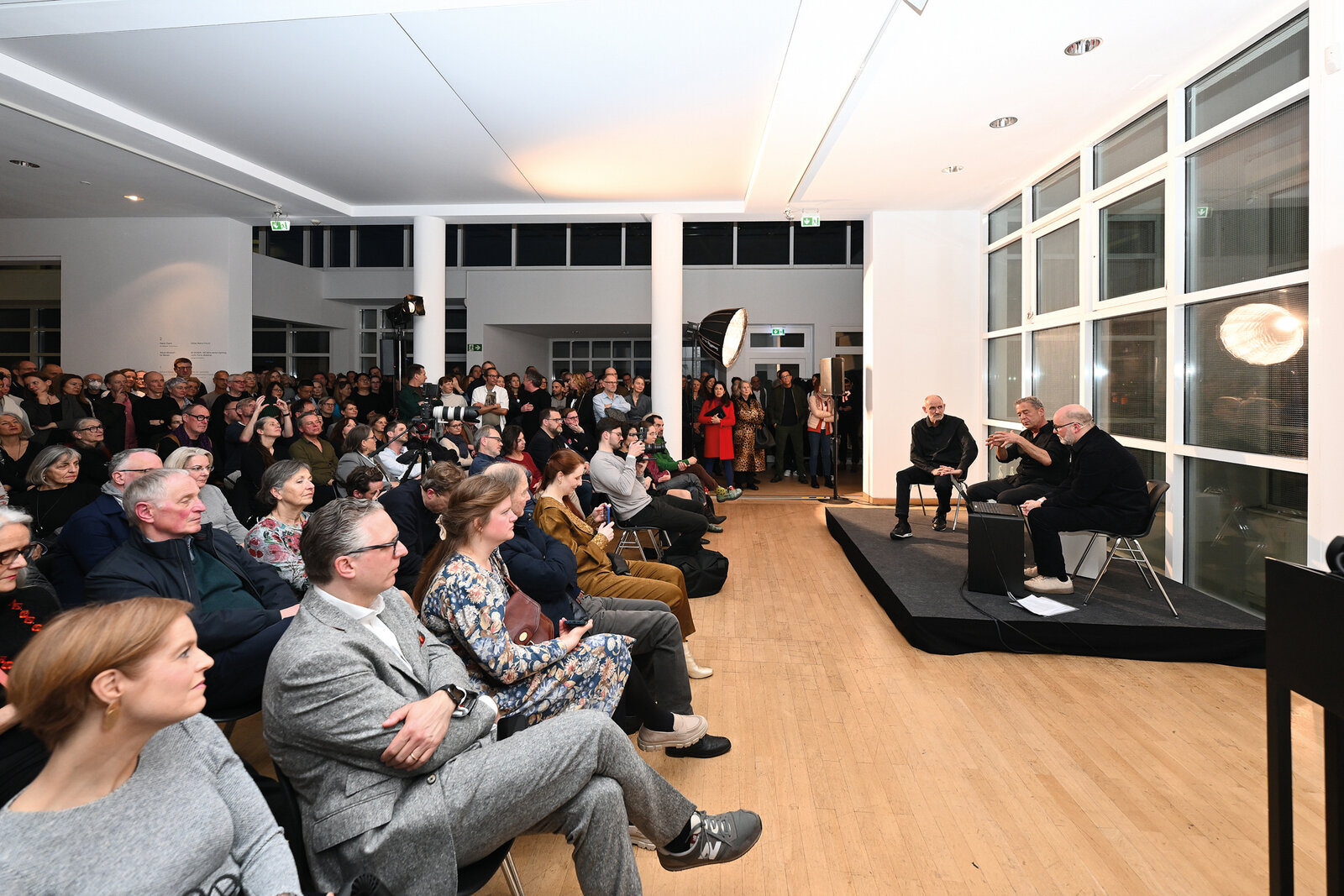
MF: We will now look a little more closely at a few of the most important and most successful serien luminaires and begin with your early designs of the 1980s, with which you also went to trade fairs for the first time. Jean-Marc, what was the unifying idea of these first, these early designs?
JMDC: So STATUS is still completely free of this influence from the Wolf side, so to speak, or from metalworking.
MW: That came via your father, didn’t it? Your father was an architect—so it was a bit architectural, wasn’t it?
JMDC: In this case not so much, perhaps later with REFLEX, but here it was more the influence of the Italian classics of the time.
MW: That’s why the granite base?
JMDC: Yes, exactly, the black marble. That was very clear: at that point I had already visited Euroluce, leafed through the magazines and knew my way around that world, and I translated that in my design head into this form. So very, very minimalist and also very simple to produce. That then did fit well into this metalworking, but completely differently from the designs that followed like LIFT or …
MF: … or VENTILATOR, for example.
JMDC: VENTILATOR is completely by Manfred and at the same time as STATUS. You can see the two very different worlds there. Ultimately it is as Manfred said. I always liked playing with Lego. You have certain building blocks and can make something great out of them, or also something boring. And this limitation—it is a certain limitation, being able to use certain materials, certain dimensions, etc.—is also a challenge. And I think we both enjoyed designing well within this limitation. You can then do it like with STATUS or like with QUADRAT, VENTILATOR or LIFT. I see a mixture of both later, for example in REFLEX.
MF: Manfred, would you like to say something more about VENTILATOR?
MW: Yes, the first design was such a mini motor. I didn’t know that it couldn’t drive it at all. With four blades the motor had to be much larger. Then we had a motor manufacturer and he had such ugly housings. That was purely practical. I then designed the housing shells for it as well. It is completely designed through. This open motor was a very important design feature and back then, as you say, the high-tech look. That was an expression that fitted it wonderfully, of course.
MF: Also QUADRAT from 1982. What was the central design idea there?
MW: That was a semester project that we did in parallel. Jean-Marc worked on LIFT and I on QUADRAT. At my father’s company, in a workshop, we worked in parallel on these two designs. As you can see, there too I had already moved a little away again from the purely open structure and used surfaces again. The nice thing about it is: at the bottom there is not a single screw in it. It is all just slotted and clicked. My father had machines with which you could do resistance welding—you know that from shopping baskets—and it’s a wonderful connection. It simply works through electricity, short circuit, welds beautifully, is a great joint, fast, looks clean. That’s one example. Then there are four soldering points that you had to silver-solder. That was also done at the company; there was such a jig.
JMDC: You were the specialist there, you soldered every luminaire for years. Hundreds …
MW: Yes, silver solder, I must have soldered LIFTs for twenty years.
MF: With LIFT from 1983 you can see nicely that you also took up the idea of Modernism, making function visible. The mechanisms are not hidden, but shown openly and become a design element of an extremely reduced, technically industrial-looking luminaire.
JMDC: One essential approach was to take up new technologies. That was the first, or one of the first, luminaires to use these so-called compact fluorescent lamps, energy-saving lamps. And the shade is like a metal coat, not fabric, designed close around the form of the light source. Although, photometrically, it is suboptimal to box it in like that. Light actually needs room to unfold, room to reflect, and so on. And this was simply designed.
MW: Exactly, light didn’t interest us that much at that time.
JMDC: Yes, light wasn’t the topic, even though we wrote: Light. Form. Material. We had no idea about light. So that’s a bit exaggerated. We did have a feel for light, but not really the understanding.
MW: If it’s about lighting technology, things very quickly become very large and not particularly attractive. Still, enough light comes out—two times nine watts.
MF: Today with LED you would find that again a lot.
MW: Yes, with fluorescent it works too.
JMDC: Thanks to this new technology in this case. And you also don’t need a diffuser because this fluorescent lamp makes very gentle, soft light anyway.
MW: But at the time it was of course frowned upon.
JMDC: Like LED at the beginning too—this is cold and so on. You could also see both luminaires, QUADRAT and LIFT, in the exhibition at the Museum Angewandte Kunst in Frankfurt, both in use—we found something in the last corners—as well as dismantled, more or less into their individual parts.
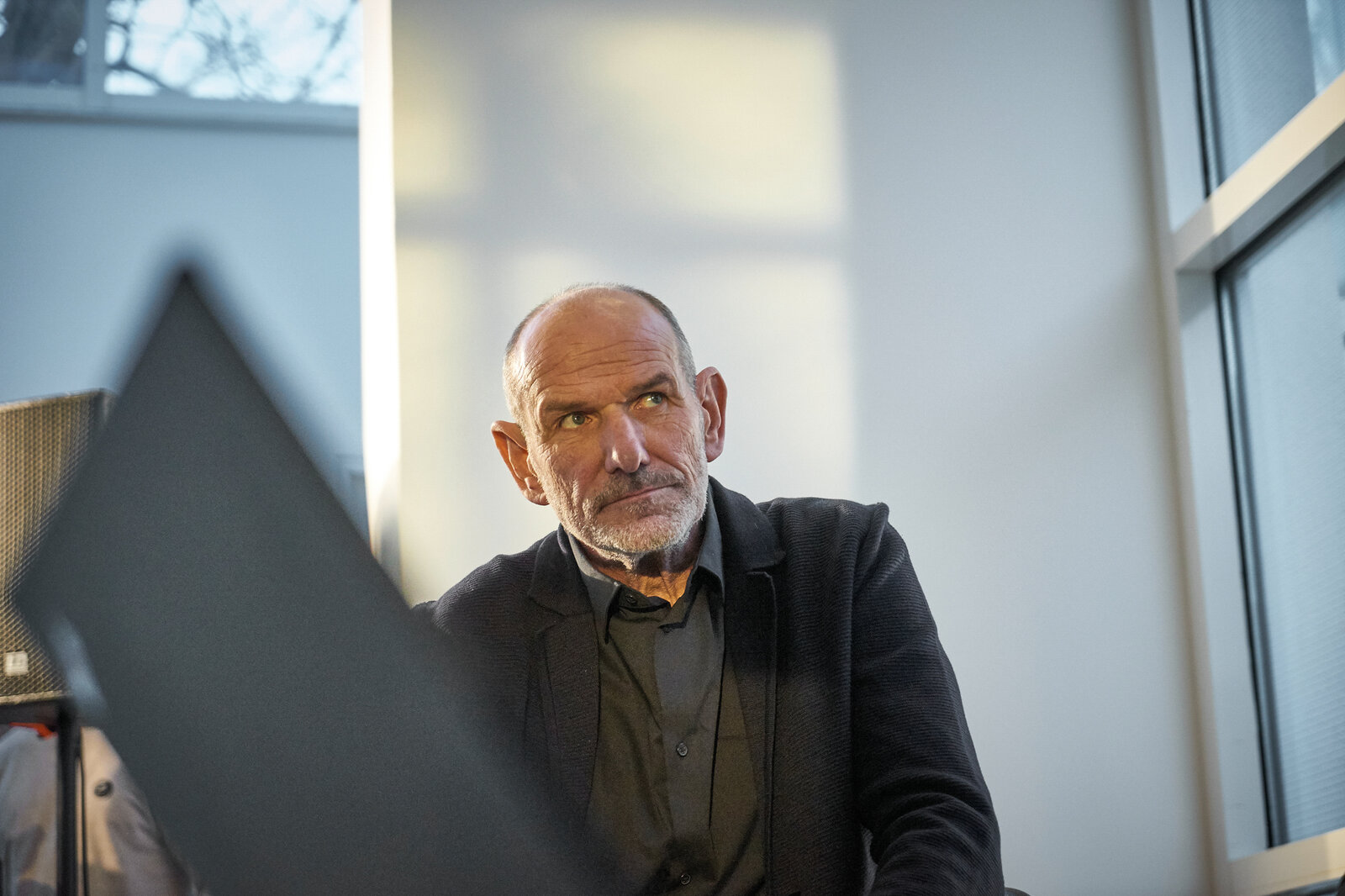
MF: We come to REFLEX, which has, for one, the idea that the luminaire brings its own reflective surface with it …
JMDC: That is actually the crucial idea.
MF: … but is also made from semi-finished products. You said the design came about before falling asleep?
JMDC: More important is where the inspiration came from. That was also a visit to Euroluce, at that time a stand by Fontana Arte showing Scintilla. They had these high-voltage halogen bulbs that produced an incredible amount of light and shone freely up at the ceiling. I was fascinated by how much light came back. The approach was to pack that into a luminaire—i.e. a luminaire that has its own reflector surface, I found that so fascinating back then.
MW: And because we had little money, we always drove from Milan by car to Lake Pusiano and camped there. The design for REFLEX was actually created in the tent in Italy.
JMDC: In the sleeping bag. And in terms of formal language it was again a return—so not the precision-mechanical, that didn’t fit here, this detailed, additive, small-part-by-small-part design, but again creating more body through surfaces. So back to where my formative influence originally was, as with STATUS. That’s why I speak of it as a mix of the two design influences.
MW: It also came at exactly the right time, of course, because it had a postmodern feel, and that was the trend par excellence back then. Although we don’t actually see it as truly postmodern, because the roof has a function—after all, the light source is in there.
MF: But of course it has a formal aesthetic.
JMDC: And it is easier to implement. Anyone who knows the press brake that you use to fold sheet knows that it’s easier than, for example, making a wave. It could have been a wave too. Might also have been nice, but it is much easier to implement like this, with semi-finished products and without tools.
MF: We come to TAKE FIVE, a design by Ginbande, by Uwe Fischer and Achim Heine—the play with the scissor-grid principle. You can adjust this luminaire with the Linestra tubes to different table sizes. Manfred, you said the design was originally much more technical.
MW: It was much more angular, yes. But then there was the problem that when you put the luminaire in a row, with the tubes all parallel one behind the other, then the upper parts were slightly shifted. They were offset a bit. Technically you can’t do it any other way, because you can’t get the scissor grid on top of itself. And then, as far as I remember, Uwe made another suggestion, and then this amorphous form came out, where that was much better. The problem was solved by that. For us, of course, that was very unusual. Back then it was also a major risk, because I think we had plastic injection-moulding tools made for 100,000 marks. So a lot of money. And what came out was a catastrophe, because the thing somehow sagged. It was warped. We then needed a very long time. We even had to build weights into the middle so that it hung more or less straight, and also change the spacing so that the torsion came out. So we nearly ran that project into the ground.
JMDC: A big challenge. That’s why I said: a huge leap.
MW: We didn’t know the technology at all. We had no idea about plastic injection moulding. I surprised myself. I think early on in my studies I once said, maybe we’ll make luminaires using plastic injection moulding someday. For me that was completely frowned upon, because I was used to metal, soldering, and not something cheap like plastic. But of course it has a great aesthetic. But that came from outside. I don’t think we would have done it. That was Uwe Fischer and Ginbande.
JMDC: I still remember how we always argued when I visited customers and presented this design. It also fitted the time. Kartell and so on. These plastic pieces of furniture were already slowly coming. I spoke of it as a design that makes plastic socially acceptable, because it has high design quality and isn’t just plastic. It was also a high-quality plastic, translucent, you could look into the luminaire from the back. And what it can do—illuminating a small area with the Linestra lamps all parallel, and then transforming them into a line and bridging a longer distance—that was the function. And also the briefing at the beginning: we said, make a luminaire for extendable tables. That was the specification.
MF: This is a bit of an evening of revelations. Now comes another one, and I’ve been looking forward to it all the time: ZOOM by Floyd Paxton from 2000. Certainly one of your best-known and also most imposing products. The press wrote back then about a contemporary chandelier. And I am very pleased that I can finally reveal something: in 2007 I was given the commission to write contributions on the subject of design and identity for Messe Frankfurt, and I wrote a column about Floyd Paxton, the designer of ZOOM. In this column I poked a bit of fun at the hype around big names in the design industry and around self-staging, using the example of Floyd Paxton, who was very mysterious and media-shy and with whom you couldn’t get an appointment. I took up the self-staging and this critical or uncritical reporting in design a bit in this column, but I didn’t reveal the secret. And with that I wrote my only article that was ever rejected by a client. Messe Frankfurt said you wouldn’t learn enough about Floyd Paxton and the designer’s biography. And I am pleased that I can finally explain today why that was. Floyd Paxton is Manfred Wolf. Manfred, why?
MW: Yes, that was because of the scissor grid. We already had a scissor-grid luminaire. And then I said, Manfred Wolf—does he now also make a scissor grid, and now it’s round? No, come on, the design suits a different name, and that’s how we came to Floyd Paxton. Paxton’s Crystal Palace, and I thought Floyd was a nice first name, so Floyd Paxton. That was all fine until we had a request from AD for an interview with a photo. Then we thought: what do we do now? Back then we had a very clever employee, Christoph Schmidt, who unfortunately is no longer alive, and he had an idea. So I went over to my mother’s, she had a wig lying around … my mother’s wig, ski goggles, and I also held my hand in front of my face. In the end we still needed the interview, but Christoph Schmidt had an email address in Holland and then said: this is a British photographer, he’s very difficult to reach and we can only answer written enquiries. And we’ve kept that secret pretty well so far.
MF: You are also welcome to say something about the design now, since you made it.
MW: We already had a scissor-grid luminaire, TAKE FIVE, and I could remember that my mother once had a kind of purse. I later heard that it is a Russian product or something. It had that as a clasp, a scissor grid, exactly like that. It had a little lid at the top that you could close.
JMDC: A pouch.
MW: Exactly, a pouch. You could open it, put something in, close it again.
JMDC: Exactly that principle.
MW: Exactly. I think I saw that once lying around at my mother’s and then at some point thought: you can also make a luminaire out of that, a scissor grid in a circle, with spring steel etc. That was also a bit of an experiment. It also has a very nice sweep, which, by the way, is not by me. The first prototype was straight and didn’t actually look very nice. But we had this Spaniard, who always talked about “curvitas”, and then said: there has to be a curve in it. That was Carlos Castellanos, who unfortunately is no longer alive either. He contributed that curve.
MF: ANNEX by Uwe Fischer. Jean-Marc, you always describe that as a display-case luminaire, this idea of the display case.
JMDC: I find that what is fascinating about this design is that what lights up—i.e. the luminaire as such, with the canopy at the top containing the technology and the opal shade at the bottom—would work like that too. And then it is, as it were, additionally wrapped in mouth-blown glass, which celebrates the whole thing and makes it special, I think. That’s why I always talk about the display-case principle. And I kept saying to Uwe: develop this great, convincing principle further, make further designs, something more modern perhaps, because it really looks like it’s from the 1940s. But at first that didn’t happen.
MW: It also has a disadvantage: the light falls through the mouth-blown glass and then produces rings, but they are uneven. And we also had quite a problem with the reflection on the ceiling. Then we made a luminaire together, CURLING, which is open at the bottom. That was one reason, but also the cooling for LED. ANNEX is still a halogen design. Cooling is very important with LED, much more important than with incandescent lamps. You wouldn’t think so, because it uses so little energy, but it has hardly any radiant heat, it has body heat, and that has to be dissipated. That is why CURLING is open at the bottom and ANNEX was closed at the bottom.
MF: We are already on the topic of halogen and LED. We will make a jump back in chronology here to SML, which was very successful especially in an architectural context and is a good example of the fact that when transitioning from halogen to LED you didn’t simply put in new light sources, as many other manufacturers did, but really redeveloped the luminaires completely. The LED version is called SML².
JMDC: The original version, the halogen version, fascinated me because I still had a fascination for these high-performance halogen linear lamps. And packing that thing into a minimal dimension and a minimal design, i.e. into a completely minimalist design, that was the fascination of this design. To put it briefly: we had a lot of success with it, we sold tens of thousands a year of it, well over tens of thousands.
MW: We couldn’t meet demand for three or four years. We always defined production runs: let’s start with 1,000—no, not enough. We do 4,000—no, not enough. In terms of deliveries we were basically always behind for a long time, because we weren’t set up for such quantities.
JMDC: And to make the jump to LED now: that was obvious. We observed LED development for a long time and saw what was happening there, some OK, some terrible. The quality of the accessory parts you could buy as a luminaire manufacturer was not satisfactory for many years at first. And we said: we have to wait until the right ingredients are far enough along that we can make a really good recipe out of them. So time passed. We didn’t react immediately, we didn’t say: we’re jumping on this LED technology too, but rather waited. And then at the right time, I think, we began with converting or re-motorising a successful model. You mentioned earlier that other luminaire manufacturers simply make a so-called retrofit or a substitute to screw into the E27 lampholder, but that wasn’t possible here. It has such a miniaturised dimension that we also had to develop our own LED board, etc. And the first prototypes were relatively awful. We had them with us at the trade fair already, but in the drawer. We didn’t even dare to really show them and then asked some experts what they thought of them. That was a long process. Until we got to the point where we had SML², the second generation in LED technology, years passed. But it was very successful too and the product still sells today. Perhaps it has aged a bit, because this formal language with a visible screw and additive parts may no longer be popular today. But there are still the absolute fans—and still thousands, fortunately.
MF: I’m also a fan, I have it in the corridor. With another luminaire, REFLEX², you can perhaps see even more strongly what the switch to LED meant. That was, as it were, a continuation of REFLEX, but with LED, which then became a completely new design.
JMDC: You can say that, yes. But this design also picks up the basic principle of a luminaire with its own reflector surface. I can briefly explain why the luminaire’s own reflector surface is so important: you are independent of the ceiling’s reflectance. That means if you have a wood-panelled ceiling and want to use this luminaire, you still get almost the same amount of light downwards. That is what fascinates me about it. When people look at this design, they think the light comes from the reflector surface, because they don’t assume that there is any light source in this filigree structure down there. But in fact it is like this: down in the square frame, which is open at the top, there are high-performance LEDs.
MW: After all, 50 watts, and they have superb cooling because it’s aluminium. So it works very well.
JMDC: The whole body cools, so to speak.
MW: Yes, that’s why it has to be made of aluminium. Zinc die casting, for example, wouldn’t work, not enough heat dissipation.
JMDC: These are no longer semi-finished products, but aluminium die-cast parts. You need huge tools for that, where the parts then, so to speak, fall out finished.
MW: We don’t make those ourselves.
MF: Those were a few exemplar luminaires by you. Now let’s look at a few important moments or milestones of serien. We’ll go back again to the beginnings in the 1980s. “Disco Uno” in Frankfurt—clubs were called discos back then—was your very first project?
MW: The first commission, yes.
MF: The very first commission?
MW: I still remember the turnover: 8,000 Deutsche Marks.
JMDC: Ridiculous, yes.
MW: That was already a lot of money, that was 1984. The architect Andreas Keller had designed it and somehow came across us. I don’t even remember how he came to us. But we designed it back then and, amusingly, for the exhibition at the Museum Angewandte Kunst we asked ourselves: where is this Uno luminaire? It was at some point torn down and thrown into some corner and then these red baffles looked so shabby. Then I said: I think there is still a box somewhere. And then we actually unpacked originally packaged, powder-coated parts from 1984 and screwed them on freshly. With us nothing gets thrown away.
MF: In 1985 you were already presenting at Stoll in Cologne and in 1987 also in Cologne at the furniture fair in a Cologne pub—a bold step you took there in the 1980s. In 1988 you had a first exhibition at the Institut für Neue Technische Form in Darmstadt and you said you also always found it great to work for synagogues or other places of worship.
JMDC: That mainly came about through acquaintance with a Jewish architect. The first synagogue, by the way, was in Darmstadt. That was after the war the first newly built synagogue in Darmstadt. For that we got the commission to illuminate all of the cultic objects …
MW: … usually chandeliers, menorah, Kaddish, memorial light and so on.
JMDC: From that a whole series developed. This architect was successful with it and it repeated. That was many years ago now. He has since built six or seven synagogues and we have illuminated them all.
MF: The exhibition “Flächendeckung” in 1990 at Frankfurt’s Carmelite Monastery was also an important milestone for you, an important exhibition.
MW: Yes, first of all a great location, being able to exhibit in the cloister of the Carmelite Monastery. We also put quite a lot of effort into it. Jean-Marc built the snake in which the little BIRDIEs shine and glued the wood together himself.
JMDC: Together with the intern, yes.
MW: Together with Stephan Meyer, that was.
MF: In 1990 you did the special lighting for the Nazarene Room at the Städel Museum.
JMDC: Yes, they are still hanging there.
MF: In 2005 your presentation at Stylepark in Residence in Cologne took place and in 2018 the fit-out of the Federal Palace in Bern, also an important moment.
MW: Yes, the Swiss have high expectations of luminaires. They had to be patinated and the glass had to be specially aged so that it fitted this listed parliament building.
JMDC: In that case it is a semi-standard development. The serially produced ANNEX turned into a four-luminaire chandelier element.
MF: In 2022 then the most recent exhibition so far at Light + Building …
JMDC: … for the first time also a completely new trade-fair stand. Before that we always had these fortresses, very architectural, conventional trade-fair construction, which then afterwards gets completely scrapped. So no longer so contemporary either. At this last fair in Frankfurt we made a much more modern, contemporary and filigree presentation. I always thought of flea-market stalls. That was the idea or the concept.
MW: We also took that up for the exhibition at the Museum Angewandte Kunst.
JMDC: Yes, I wanted to mention that. I was always occupied with trade fairs, and we had never done anything for a museum before. For me that was initially a completely new subject. And luckily Manfred had such a clear view and provided the decisive inspirations, building on this system to use a very clear—I always say “socialist system”. Every luminaire gets the same footprint, no more and no less, and is treated equally. The successful models are not particularly highlighted, nor the bad ones somehow less, but all equal. And I found that: it fits the architecture of the Museum Angewandte Kunst, it fits our company name, it fits the exhibition name.
MF: In 2023 then another place of worship, the inauguration of the Weill Synagogue in Dessau. Manfred, you said that for you there are also repeatedly nice moments outside these prestigious projects, when you walk through the city at night.
MW: Yes, of course it is always great when the children are sent out into the wide world and in some cities you look into flats and see the luminaires hanging. That was, I think, also an idea we had. We always pressed our noses flat against the shop windows here before we started our own series, and said: we would like our luminaires to be visible somewhere in a shop window. That was definitely the case. There were some well-known furniture shops here: Leptien 3, which still exists. And on Berliner Straße there was Behr. In the evenings we stood in front of it with the car and looked at it. We wanted our stuff to be hanging there too.
MF: Sometimes you also get pictures sent by customers (shows image of a restaurant with ZOOM chandeliers and the Opera House in Sydney in the background).
MW: Yes, if you look out of the window there, you can see roughly where that is, if you know a bit about architecture. Great restaurant. Unfortunately it doesn’t exist anymore. I haven’t been to Australia yet, but it’s very nice, something like that.
JMDC: Sydney.
MF: You also said that you always find it especially nice when your luminaires appear in films.
MW: Yes, that really is a surprise moment. You watch some film on television in the evening and suddenly you see the luminaires. They are built into the set. We don’t know that. We have nothing to do with it.
JMDC: We didn’t deliberately push that, or anything like that. We didn’t pay for product placement.
MF: We are slowly coming to the end. With the exhibition at the Museum Angewandte Kunst you celebrated the 40th anniversary. Where is serien headed in the future? Where are you steering towards?
JMDC: We have no plan. We definitely have no plan, but we still have enthusiasm. Manfred set up a monster ZOOM specifically for the exhibition at the Museum Angewandte Kunst, in the outdoor area.
MW: We persuaded Floyd Paxton. We didn’t have to coordinate for very long with the designer (laughs).
JMDC: And I too, for the exhibition, designed and realised a small serien luminaire within six weeks, which could be seen at Emma Metzler, a restaurant here in Frankfurt. That is our driving force. That is the plan. As long as we still have joy, energy and fun in the work.
MF: Manfred and Jean-Marc, many thanks for the conversation.